Regional Behavioral Health Specialists connect Missourians to life-changing resources while supporting staff across the state.

Story by Marcus Wilkins. Photos by Garry Brix.
Sarah Lee has probably heard all the jokes about the name she almost shares with the famed food corporation. (The sweet-treat company skips the “h.”)
But as a dynamic member of the Regional Behavioral Health Specialist (RBHS) team, tasked with connecting Missouri Department of Corrections (MODOC) clients with valuable resources across the state, it seems that “nobody doesn’t like” her.
Today, Lee is working the RBHS table at a resource fair in the Missouri Eastern Correctional Center (MECC) gymnasium, where residents flow through by the hundreds to gather information in anticipation of their eventual release.
Friendly, efficient and highly organized, Lee jots down each resident’s MODOC number and a brief description of their needs. Later, she compiles a customized list of resources and records it in the client’s automated road book (ARB), where institutional parole officers (IPOs) and case managers can access it.
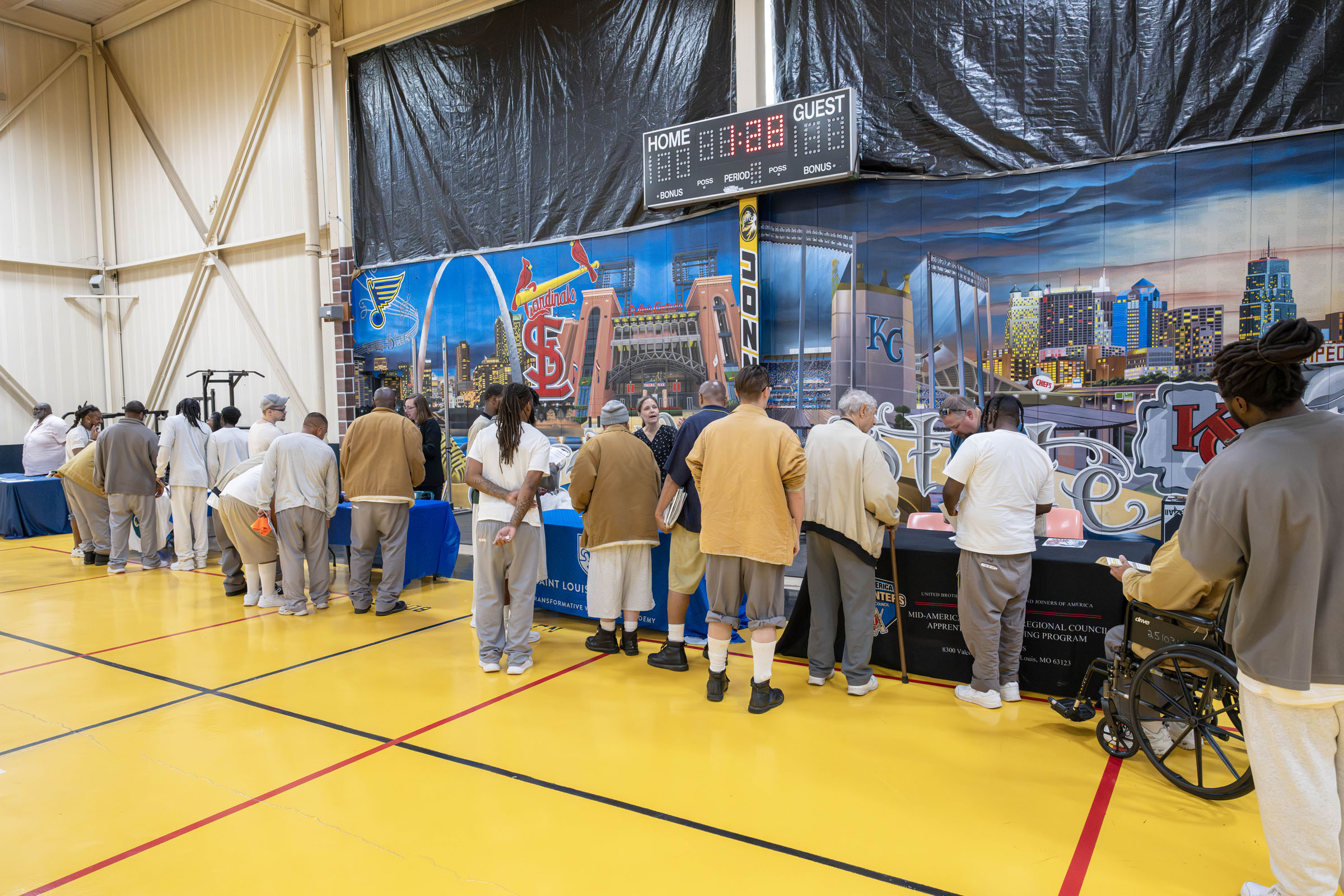
MECC resource fair.
“I tell the residents, ‘Remember today’s date and this resource fair so that you can tell them what you discussed with me,’” says Lee, the RBHS team’s eastern region representative. “My main goal is to find the gaps for clients, and probation and parole (P&P) staff and then bridge them.”
The RBHS team comprises seven positions — six regional representatives and one coordinator — serving all 114 Missouri counties. Specialists help connect clients with appropriate behavioral health services while supporting continuity of care throughout supervision and reentry. They also assist probation and parole staff by sharing behavioral health expertise, coordinating stakeholder partnerships and providing training.
For example, a former client of Lee’s with a traumatic brain injury had stopped progressing — missing appointments and failing to check in with supervision staff — and P&P staff struggled to find adequate services for her. Lee connected the parole officer (PO) to the Department of Mental Health’s Adult Brain Injury Program, which helped the client access specialized medical care, housing, transportation and vocational training.
“To do this job, you really have to care about the bigger mission,” Lee says. “Sometimes, because of roadblocks or other challenges, there are problems that I can’t solve. But I can do my best to provide clients with information. Whether they use those resources is ultimately up to them.”
Connecting the Dots

About 100 miles west in Jefferson City, Melissa Adams is performing Lee’s process essentially in reverse. Instead of staffing a resource table, Adams is walking a room, gathering contacts and information at a Community Resource Fair hosted by Catholic Charities of Northern Missouri.
A natural networker, Adams, the RBHS south central region representative, finds plenty to value in the reconnaissance mission. The event brings together 32 organizations, including Compass Health, Faith Maternity Care, Landmark Recovery and Truman VA Hospital.
“This is second nature to me because I was the resource guru back when I was a probation officer,” says Adams, who has held various MODOC roles spanning 16 years. “There are lots of resources out there, but sometimes you have to dig for them and figure out things like, ‘What does one area have that another doesn’t? Where are the nearest inpatient facilities, food banks or financial education organizations?’”
Adams discovered her passion for service as a teenager in her hometown of Cuba, Missouri, where she once sneaked out of the house to attend a high school party and was caught. As a consequence of her misbehavior, her father required her to perform community service, leading her to Head Start — the federal program for low-income children and families.
Adams eventually went on to work at Boys and Girls Town in St. James and quickly learned that children in those programs often have parents in the criminal justice system.
“Many of the kids weren’t able to make significant changes because they would go right back to the same dysfunctional house that they came from,” Adams says. “I remember thinking, ‘If I want to help the kids, I have to help the parents.’”
Lee also found a calling to this type of work as a community support specialist, substance use counselor and supervisor at Compass Health. She joined MODOC in 2015 as an institutional parole officer at Boonville Correctional Center (BCC), where she took on the domestic violence and sex offender caseload and witnessed firsthand how difficult it could be to connect clients with scarce resources.
“There’s a huge shortage of providers for that population, and that’s actually one of our goals as an RBHS team — to recruit more sex offender providers,” Lee says. “We wear a lot of hats. We’re a small group, but we get a lot done.”
Beyond the Map
Adams’ territory — 30 contiguous counties from the edge of St. Louis down into the heart of the Ozarks and across to the wide-open western plains — takes her through some of the Show-Me State’s most scenic byways. It also brings her into contact with organizations and recovery programs that might not align with best-practices standards established by the Missouri Coalition of Recovery Support Providers (MOCRSP). As a result, Adams and her P&P colleagues have visited rural recovery programs and subsequently worked with the Missouri court system to change supervision conditions and suggest preferred recovery programs.
It’s just one example of the many outreach responsibilities handled by the RBHS team.
“Melissa has been a great resource if I’m stuck in my tracks or having difficulty getting through to an offender [with a mental health condition],” said Rusty Green, probation and parole officer II at Jefferson City Correctional Center (JCCC). “We can brainstorm together to find the treatment that best fits that individual. Without the behavioral health specialists’ expertise, we might not make those connections.”
The work also demands constant collaboration and communication among team members, areas in which the RBHS squad excels. Each specialist develops deep knowledge of their assigned region while collaborating closely with teammates when clients’ needs cross regional boundaries.
“Every member has their own unique strengths that provide balance and a collaborative problem-solving approach,” said Jessica Feldmann, behavioral health coordinator. “They are a group of highly motivated professionals who strive to ensure our clients receive the quality services they need to be successful in the community.”
Adams echoes that sentiment.
“We are a great team, interconnecting and talking every single day, multiple times a day,” Adams said. “We’ll ask, ‘Do you know about this or that program?’ always looking out for each other. I couldn't do what I’m doing without them.”